Subterranean termite treatment in Orlando requires defensive applications tailored to Orange County soil profiles and seasonal rainfall patterns. In established neighborhoods like College Park, Thornton Park, and…
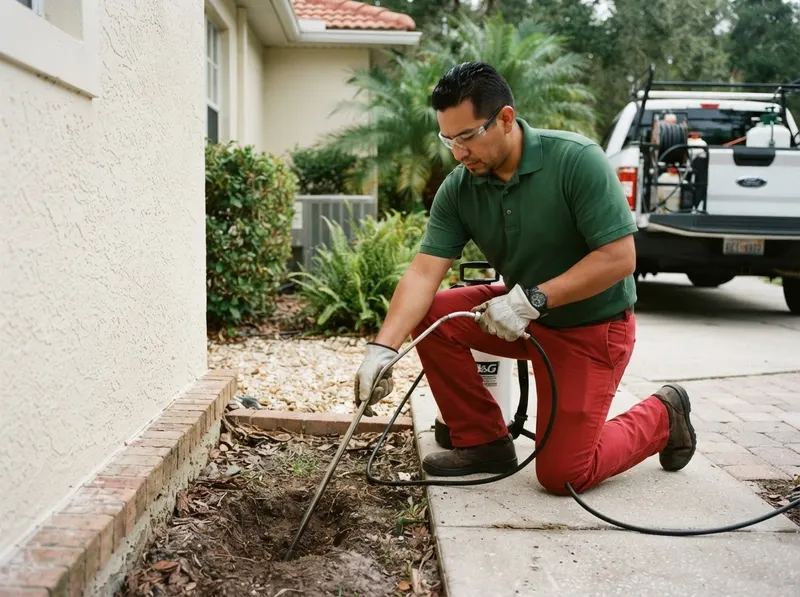
Subterranean termite treatment in Orlando requires defensive applications tailored to Orange County soil profiles and seasonal rainfall patterns. In established neighborhoods like College Park, Thornton Park, and Delaney Park, historic wood-frame homes sitting on off-grade pier-and-beam foundations demand direct crawlspace soil saturation and interior pier trenching. Because subterranean termites require ground contact for moisture, sandy soil beds near Lake Eola Park and Harry P. Leu Gardens allow rapid tunnel construction through mud shelter tubes. Modern concrete slab construction in Baldwin Park, Lake Nona, and Dr. Phillips presents a different architectural risk, where colonies enter unseen through 1/16th-inch expansion joints, plumbing penetrations, and bath traps beneath tile floors.
Decision guidance depends on the home foundation style and confirmed activity points. If structural framing displays active mud tubes or internal wall damage, a continuous liquid termiticide barrier applied via a 6-inch by 6-inch perimeter trench provides immediate transfer throughout the nesting population. If a homeowner seeks preventive property boundary monitoring without trenching root systems or paved pool decks in MetroWest or Audubon Park, an exterior bait station grid placed every 10 to 15 linear feet serves as the appropriate protocol. The trade-off centers on intervention speed versus surface alteration: liquid soil barriers halt active foraging within days by transferring active ingredients directly between grooming workers, while baiting matrices require several weeks for colony consumption but avoid structural drilling through patio pavers and decorative front entries.
Technical perimeter defense addresses Central Florida sub-tropical moisture pockets that negate standard pest applications. Standard surface bug sprays do not affect subterranean colonies nested 5 to 10 feet beneath the surface grade. Liquid barrier protocols deposit non-repellent formulations 4 gallons per 10 linear feet into backfilled soil trenches, binding to substrate grains without evaporating into interior living spaces. This application method produces no airborne indoor odors or baseboard staining. Localized treatments meet isolated issues at the $250 service minimum, while comprehensive residential perimeter treatments average 150 to 250 linear feet of treated foundation.
Every job gets a firm, written price after a free on-site visit.
Tell us about your subterranean termite treatment job in Orlando and we'll send a clear, written quote, usually the same day.
 SureNest Pest Control