Orlando residential landscapes feature deep sandy soils, high relative humidity, and microclimates that foster rapid parasitic development. Ectoparasites thrive under dense tree canopies and shaded foundation plantings…
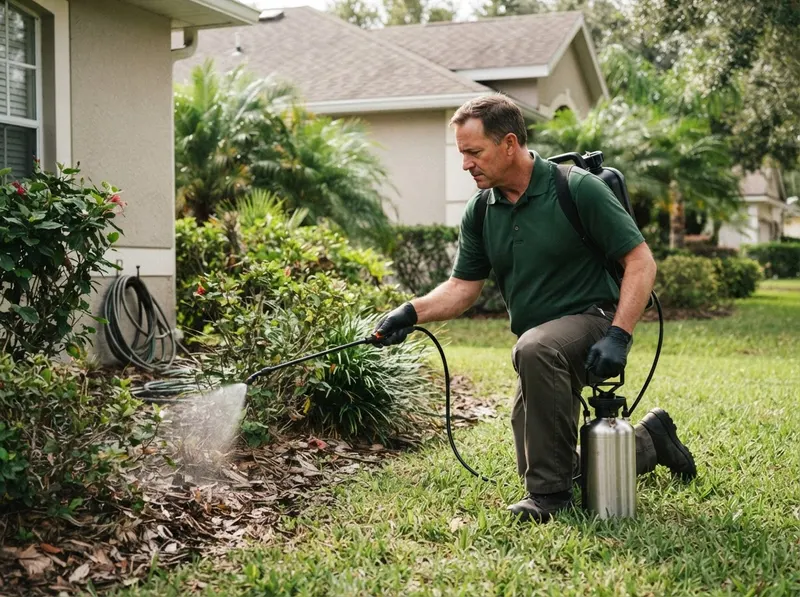
Orlando residential landscapes feature deep sandy soils, high relative humidity, and microclimates that foster rapid parasitic development. Ectoparasites thrive under dense tree canopies and shaded foundation plantings in historic zones like College Park, Thornton Park, and Delaney Park. In newer developments such as Lake Nona or master-planned communities like Baldwin Park, irrigation lines saturate St. Augustine and Zoysia turf grasses daily. This regular moisture creates an ideal incubation pocket for flea pupae and questing ticks along patio perimeters and fence lines. Untreated perimeter grass allows larvae to mature inside dark mulch layers before latching onto domestic pets or crossing door thresholds.
Effective exterior treatment pairs a liquid adulticide with a photostable insect growth regulator (IGR) across all moist, shaded ground matter. While adulticides eliminate mobile parasites upon contact, the IGR arrests juvenile development by preventing flea larvae from spinning protective cocoons and halting tick nymphs from molting into breeding adults. A single application does not replace standard veterinary topical treatments; the yard barrier functions as an environmental containment shield. Open, sun-scorched turf requires minimal pesticide volume because direct UV exposure and surface heat naturally desiccate flea larvae. Instead, product volume concentrates along shaded drip lines under oaks, beneath low-hanging palms, along structural foundations, and around elevated decking.
Property size and vegetation density dictate exact protocol deployment across Orange County neighborhoods. Compact parcels in Audubon Park with thick ornamental landscaping require precise handheld perimeter spray nozzles to penetrate beneath broadleaf foliage without drifting onto non-target flowering annuals. Expansive suburban properties in Dr. Phillips, Rosemont, or MetroWest necessitate high-volume, pressure-regulated equipment to push active ingredients through thatch layers down to the soil interface where flea larvae shelter. Trade-offs exist: liquid residual barriers degrade faster under torrential summer afternoon thunderstorms, necessitating re-treatment intervals of 30 to 45 days during peak heat, whereas granular formulations offer slower dissolution through heavy rainfall but lack immediate adult knockdown capabilities.
Every job gets a firm, written price after a free on-site visit.
Tell us about your fleas and tick yard treatment job in Orlando and we'll send a clear, written quote, usually the same day.
 SureNest Pest Control